Handling parameters
Why such a section ?
For ECG or Respiration signal processing, physio proposes compute_ecg() and compute_respiration(),
some high-level wrapper functions that deeply simplify the workflow for the user.
However, these functions come with a tree of parameters that have been predefined by the developers.
Variability during data acquisition (subject, acquisition system) can affect the recorded signals.
Such variability may make some predefined parameters of physio inappropriate.
In this situation, we encourage the user to fine tune certain parameters by re-assigning values to the keys of the parameters dictionary
got from the physio.get_ecg_parameters() or physio.get_respiration_parameters().
To fine-tune parameters properly, a good understanding of each parameter’s role is required… and this why we wrote this section.
Organization
- This tutorial is organized into two major sections, each of which is divided into multiple subsections:
Respiration parameters
sentor_type = airflow
preprocess
smooth
cycle_detection
cycle_clean
baseline
sentor_type = belt
preprocess
smooth
cycle_detection
cycle_clean
baseline
sentor_type = co2
preprocess
smooth
cycle_detection
baseline
cycle_clean
ECG parameters
human
preprocess
peak_detection
peak_clean
rat
preprocess
peak_detection
peak_clean
1. Respiration Parameters
For now, we have developed capabilities in physio to process respiration recorded with three types of sensors: airflow, belt, and co2.
The sensor type drives many of the subsequent parameters, from preprocessing to metric computation, and therefore affects which metrics can be computed.
Note that for the rat species, rat_plethysmo is equivalent to an airflow signal, even though it is much faster.
Similarly, rat_etisens_belt is equivalent to a human belt signal.
This section will detail the parameter settings for each of these sensor types.
a. airflow
Default parameters dictionary for airflow sensor (for human species). In the case of rat_plethysmo, our description is not detailed because the approach is the same; only the parameters are optimized to match the rat’s respiratory frequency.
{
    'baseline': {
        'baseline_mode': 'median'
    },
    'cycle_clean': {
        'low_limit_log_ratio': 4.5,
        'variable_names': ['inspi_volume', 'expi_volume']
    },
    'cycle_detection': {
        'epsilon_factor1': 10.0,
        'epsilon_factor2': 5.0,
        'inspiration_adjust_on_derivative': False,
        'method': 'crossing_baseline'
    },
    'preprocess': {
        'band': 7.0,
        'btype': 'lowpass',
        'ftype': 'bessel',
        'order': 5
    },
    'sensor_type': 'airflow',
    'smooth': {
        'sigma_ms': 60.0,
        'win_shape': 'gaussian'
    }
}
preprocess:
The preprocess key controls how the raw respiratory signal is filtered. This is done using scipy.signal.iirfilter (see: https://docs.scipy.org/doc/scipy/reference/generated/scipy.signal.iirfilter.html). Several subkeys relate to controlling this filtering:
btype: The type of filter. In this context, we set a lowpass, but it could be bandpass to remove slow drifts by setting low and high cutoffs.
band: The cutoff frequency. For a lowpass, this is the high cutoff, set to 7 Hz by default. This parameter strongly affects the precise timing of respiratory cycle timepoint detection. Decreasing this value increases signal smoothness but may artificially shift the inspiration-expiration transition.
ftype: The type of filter. For example, bessel (default) or butter. We recommend bessel because it preserves time-domain fidelity, although it is slightly less steep in frequency cutoff.
order: The filter order. Default = 5. Higher order → steeper frequency cutoff but increases the risk of phase distortion.
smooth:
The smooth key controls how the filtered respiratory signal is smoothed again using convolution with a kernel. Subkeys relate to the size and shape of this kernel:
win_shape: Default = gaussian. The kernel shape is Gaussian. It can be set to rect for a rectangular kernel, but we recommend gaussian because it reduces discontinuities in time, even if its frequency response is less steep than rect.
sigma_ms: Kernel size in milliseconds. Higher → smoother; lower → less smooth. Default = 60 ms.
cycle_detection:
This key controls how the main timepoints (inspiration and expiration) are detected:
method: crossing_baseline in this case, because the signal returns to baseline when there is no flow (unlike belt and CO2 signals, where the method is set to min_max).
epsilon_factor1: Defines a horizontal confidence zone just below the true baseline, where the low part = baseline - epsilon * epsilon_factor1, with epsilon = (baseline - np.quantile(resp, 0.1)) / 100. Allows to compute the epsilon 1 in green on the figure below.
epsilon_factor2: Defines the higher part of the confidence zone: baseline - epsilon * epsilon_factor2. epsilon_factor1 is higher than epsilon_factor2 to search the upper part of the confidence zone. Allows to compute the epsilon 2 in orange on the figure below. At this amplitude, will be detected the green dots of the figure, meaning the inspiration starts. Expiration (red dot) starts are detected right at the baseline level (blue horizontal line on the figure).
inspiration_adjust_on_derivative: Sometimes the end-of-expiration plateau drifts downward, causing premature detection of inspiration. Activating this parameter adjusts detection using the slope’s minimum (second derivative). Default = False.

cycle_clean:
This key controls how already detected timepoints are cleaned. Small oscillations in a noisy signal can cause very small cycles to be detected when the signal crosses the baseline. Subkeys specify criteria for identifying these outliers:
variable_names: Names of respiratory features used to detect outliers. Default = [‘inspi_volume’, ‘expi_volume’]. Volumes are chosen because they capture cycles that are too small both in time and amplitude.
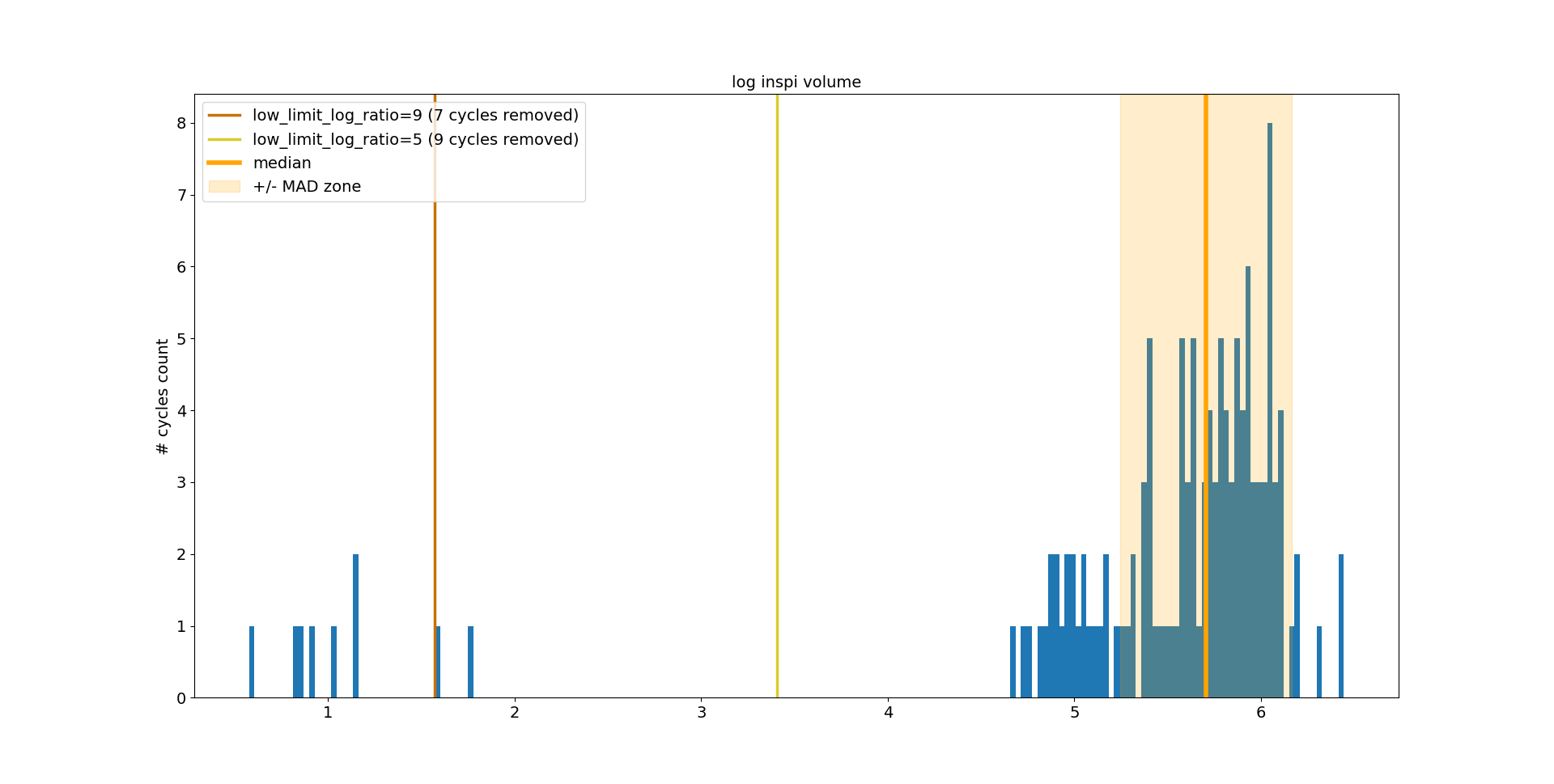
low_limit_log_ratio: Features are often non-normally distributed and are log-transformed before threshold estimation. The threshold for outliers is computed as median - MAD * low_limit_log_ratio. Higher low_limit_log_ratio → smaller detected cycles → fewer outliers detected. On the figure you can see that by increasing the low_limit_log_ratio, the log inspi_volume threshold has been shifted to the left meaning removing less cycles (7 vs 9 on this example).
baseline:
Controls how the baseline of the signal is computed:
baseline_mode: Default = median, meaning the baseline is the median level of the signal (robust and efficient). Alternatives: zero (baseline = 0) or mode (mode of the signal distribution).
b. belt
Default parameters dictionary for belt sensor: In the case of rat_etisens_belt, our description is not detailed because the approach is the same; only the parameters are optimized to match the rat’s respiratory frequency.
{
    'baseline': None,
    'cycle_clean': {
        'low_limit_log_ratio': 8.0,
        'variable_names': ['inspi_amplitude', 'expi_amplitude']
    },
    'cycle_detection': {
        'exclude_sweep_ms': 200.0,
        'method': 'min_max'
    },
    'preprocess': {
        'band': 5.0,
        'btype': 'lowpass',
        'ftype': 'bessel',
        'order': 5
    },
    'sensor_type': 'belt',
    'smooth': {
        'sigma_ms': 40.0,
        'win_shape': 'gaussian'
    }
}
preprocess:
The preprocess key controls how the raw respiratory signal is filtered. This is done using scipy.signal.iirfilter (see: https://docs.scipy.org/doc/scipy/reference/generated/scipy.signal.iirfilter.html). Several subkeys control this filtering:
btype: The type of filter. In this context, we set a lowpass, but it could also be bandpass to remove slow drifts by setting low and high cutoffs.
band: The cutoff frequency. For a lowpass, this is the high cutoff, set to 5 Hz by default. This parameter strongly affects the precise timing of respiratory cycle timepoint detection. Decreasing this value increases smoothness but may artificially shift the inspiration–expiration transitions.
ftype: The filter type. For example, bessel (default) or butter. We recommend bessel because it preserves time-domain fidelity, although it is less steep in frequency cutoff.
order: The filter order. Default = 5. Higher order → steeper frequency cutoff but with increased risk of phase distortion.
smooth:
The smooth key controls how the filtered respiratory signal is smoothed again using convolution with a kernel. Subkeys define the size and shape of this kernel:
win_shape: Default = gaussian. The kernel shape is Gaussian. It can be set to rect for a rectangular kernel, but we recommend gaussian because it reduces temporal discontinuities, even if its frequency response is less steep than rect.
sigma_ms: Kernel size in milliseconds. Higher → smoother; lower → less smooth. Default = 40 ms.
cycle_detection:
This key controls how the main timepoints (inspiration and expiration) are detected:
method: min_max in this case, because the signal captures trunk circumference. The signal reaches its maximum at the inspi–expi transition and its minimum at the expi–inspi transition.
exclude_sweep_ms: Time window in milliseconds swept along the signal to prevent detecting multiple peaks (maxima and minima) in noisy data. Higher = risk of losing true peaks and cycles; lower = risk of detecting spurious small outlier cycles.
cycle_clean:
This key controls how already detected timepoints are cleaned. Small oscillations in a noisy signal can cause very small cycles to be detected. Subkeys specify criteria for identifying these outliers:
variable_names: Names of respiratory features used to detect outliers. Default = [‘inspi_amplitude’, ‘expi_amplitude’]. Amplitudes are chosen because they capture cycles that are too small in both time and amplitude.
low_limit_log_ratio: Features are often non-normally distributed and are log-transformed before threshold estimation. The outlier threshold is computed as median - MAD * low_limit_log_ratio. Higher low_limit_log_ratio → smaller detected cycles → fewer outliers detected. See figure titled “log inspi_volume” of this tutorial.
baseline:
None, because this is not a crossing_baseline signal.
c. CO2
Default parameters dictionary for co2 sensor:
{
    'baseline':None,
    'cycle_clean': None,
    'cycle_detection': {
        'clean_by_mid_value': True,
        'method': 'co2',
        'thresh_expi_factor': 0.05,
        'thresh_inspi_factor': 0.08
    },
    'preprocess': {
        'band': 10.0,
        'btype': 'lowpass',
        'ftype': 'bessel',
        'order': 5
    },
    'sensor_type': 'co2',
    'smooth': {
        'sigma_ms': 40.0,
        'win_shape': 'gaussian'
    }
}
preprocess:
The preprocess key controls how the raw respiratory signal is filtered. This is done using scipy.signal.iirfilter (see: https://docs.scipy.org/doc/scipy/reference/generated/scipy.signal.iirfilter.html). Several subkeys control this filtering:
btype: The type of filter. In this context, we set a lowpass, but it could also be bandpass to remove slow drifts by setting both low and high cutoffs.
band: The cutoff frequency. For a lowpass, this is the high cutoff, set to 10 Hz by default. This parameter strongly affects the precise timing of respiratory cycle timepoint detection. Decreasing this value increases smoothness but may artificially shift the inspiration–expiration transitions.
ftype: The filter type. For example, bessel (default) or butter. We recommend bessel because it preserves time-domain fidelity, although it is slightly less steep in frequency cutoff.
order: The filter order. Default = 5. Higher order → steeper frequency cutoff but increases the risk of phase distortion.
smooth:
The smooth key controls how the filtered respiratory signal is further smoothed using convolution with a kernel. Subkeys define the size and shape of this kernel:
win_shape: Default = gaussian. The kernel shape is Gaussian. It can be set to rect for a rectangular kernel, but we recommend gaussian because it reduces temporal discontinuities, even if its frequency response is less steep than rect.
sigma_ms: Kernel size in milliseconds. Higher → smoother; lower → less smooth. Default = 40 ms.
cycle_detection:
This key controls how the main timepoints (inspiration and expiration) are detected:
method: co2 in this case, meaning a dedicated method (not a true min_max). The goal is to detect transitions from expiration to inspiration at the end of the expiration plateau, and transitions from inspiration to expiration at the end of the inspiration plateau, using the first derivative of the signal.
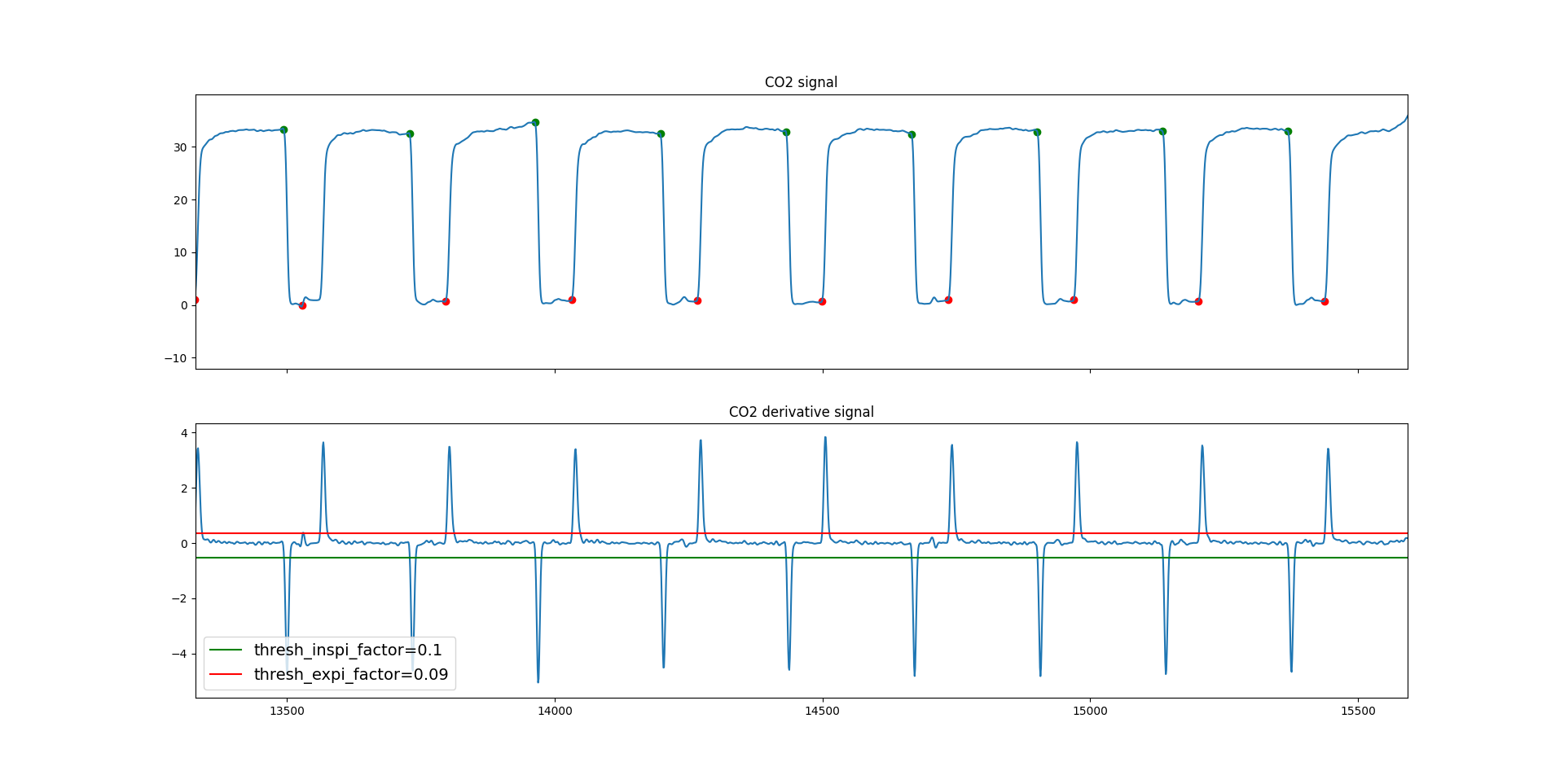
thresh_expi_factor: To detect expiration timepoints, we search for crossings in the first derivative just above 0 using a threshold. Indeed, nspiration–expiration transitions appear as upward-oriented peaks in the derivative. The threshold is computed as thresh_expi = max_ * thresh_expi_factor, where max_ is the maximum of the derivative signal. Thus, thresh_expi_factor defines the fraction of the maximum derivative used to set the threshold. See red horizontal line on the figure below.
thresh_inspi_factor: To detect inspiration timepoints, we search for crossings in the first derivative just below 0 using a threshold. Indeed, expiration–inspiration transitions appear as downward-oriented peaks in the derivative. The threshold is computed as thresh_inspi = min_ * thresh_inspi_factor, where min_ is the minimum of the derivative signal. Thus, thresh_inspi_factor defines the fraction of the minimum derivative used to set the threshold. See green horizontal line on the figure below.
clean_by_mid_value: Occasionally, abnormal cycles are detected where expiration points are too high to be real transitions. To correct this, a cleaning step computes mid_value = (np.median(insp_values) + np.median(exp_values)) / 2. If the expiration point lies above this value, the cycle is removed. Default = True.
cycle_clean:
None. We did not develop a dedicated cycle_clean method for CO2 signals, because they are generally clean enough, and partial cleaning is already performed in the cycle_detection step. Moreover, volumes are not computed for this type of signal and therefore cannot be used as criteria for cleaning.
baseline:
None. No need for baseline in CO2 context.
2. ECG parameters
For now, we have developed capabilities in physio to process ECG recordings from two species: human and rat.
The species type determines many of the preprocessing parameters, mainly because the expected heart rate is much higher in rodents than in humans.
Note that we did not develop a preset dedicated to mice, as we did not have data available to generate one. However, the rat parameters can likely be slightly tuned to fit the higher expected heart rate of mice.
In addition, any heart rate range (from any species or under any behavioral condition) can theoretically be processed by physio simply by tuning the parameters accordingly. Feel free to do so.
This section details the parameter settings for each of the two species predefined in physio.
a. human
Default parameters dictionary for human_ecg:
{
    'peak_clean': {
        'min_interval_ms': 400.0
    },
    'peak_detection': {
        'exclude_sweep_ms': 4.0,
        'thresh': 'auto'
    },
    'preprocess': {
        'band': [5.0, 45.0],
        'ftype': 'bessel',
        'normalize':True,
        'order': 5
    }
}
preprocess:
The preprocess key controls how the raw ECG signal is filtered. This is done using scipy.signal.iirfilter (see: https://docs.scipy.org/doc/scipy/reference/generated/scipy.signal.iirfilter.html). Several subkeys control this filtering:
band: The cutoff frequencies of the filter. Set to [5.0, 45.0] Hz by default. The aim of this frequency band is to increase the signal-to-noise ratio, where the signal corresponds to the R peaks and the noise is the rest. The 5–45 Hz range isolates the human R-peak frequency band, facilitating subsequent R-peak detection.
ftype: The filter type. For example, bessel (default) or butter. We recommend bessel because it preserves time-domain fidelity, although it is slightly less steep in frequency cutoff.
order: The filter order. Default = 5. Higher order → steeper frequency cutoff but increases the risk of phase distortion.
normalize: Default = True. Normalize the signal : (sig - Median(sig)) / MAD(sig) where MAD is the median absolute deviation. Useful for peak detection.
peak_detection:
The peak_detection key controls the methods by which R peaks are detected. The idea is to set a threshold above which peaks (hopefully R peaks) are detected. The two questions are: “which threshold?” and “how to remove extra peaks that are above the threshold but are not R peaks?”. Subkeys address these questions:
thresh: Default = auto. If a float is passed, this float value is used as a horizontal threshold above which R peaks are detected. auto means the threshold is automatically computed as half of the 99th percentile of the signal: thresh = np.quantile(clean_ecg, 0.99) / 2.
exclude_sweep_ms: Default = 4 milliseconds. Time window in milliseconds swept along the signal to prevent detecting multiple noisy peaks. Higher = risk of losing true R peaks; lower = risk of detecting extra non-R peaks.
peak_clean:
This key controls post-cleaning of detected R peaks by setting a minimum horizontal distance between R peaks (RR intervals) below which RR intervals are removed. The only subkey is:
min_interval_ms: Default = 400 milliseconds in this case of a human. A higher value risks removing true RR intervals, which may happen in individuals with fast heart rates.
b. rat
Default parameters dictionary for rat_ecg:
{
    'peak_clean': {
        'min_interval_ms': 50.0
    },
    'peak_detection': {
        'exclude_sweep_ms': 4.0,
        'thresh': 'auto'
    },
    'preprocess': {
        'band': [5.0, 200.0],
        'ftype': 'bessel',
        'normalize':True,
        'order': 5
    }
}
preprocess:
The preprocess key controls how the raw ECG signal is filtered. This is done using scipy.signal.iirfilter (see: https://docs.scipy.org/doc/scipy/reference/generated/scipy.signal.iirfilter.html). Several subkeys control this filtering:
band: The cutoff frequencies of the filter. Set to [5.0, 200.0] Hz by default. The aim of this frequency band is to increase the signal-to-noise ratio, where the signal corresponds to the R peaks and the noise is the rest. The 5-200 Hz range isolates the rat R-peak frequency band, facilitating subsequent R-peak detection.
ftype: The filter type. For example, bessel (default) or butter. We recommend bessel because it preserves time-domain fidelity, although it is slightly less steep in frequency cutoff.
order: The filter order. Default = 5. Higher order → steeper frequency cutoff but increases the risk of phase distortion.
normalize: Default = True. Normalize the signal : (sig - Median(sig)) / MAD(sig) where MAD is the median absolute deviation. Useful for peak detection.
peak_detection:
The peak_detection key controls the methods by which R peaks are detected. The idea is to set a threshold above which peaks (hopefully R peaks) are detected. The two questions are: “which threshold?” and “how to remove extra peaks that are above the threshold but are not R peaks?”. Subkeys address these questions:
thresh: Default = auto. If a float is passed, this float value is used as a horizontal threshold above which R peaks are detected. auto means the threshold is automatically computed as half of the 99th percentile of the signal: thresh = np.quantile(clean_ecg, 0.99) / 2.
exclude_sweep_ms: Default = 4 milliseconds. Time window in milliseconds swept along the signal to prevent detecting multiple noisy peaks. Higher = risk of losing true R peaks; lower = risk of detecting extra non-R peaks.
peak_clean:
This key controls post-cleaning of detected R peaks by setting a minimum horizontal distance between R peaks (RR intervals) below which RR intervals are removed. The only subkey is:
min_interval_ms: Default = 50 milliseconds in this case of a rat. A higher value risks removing true RR intervals, which may happen in individuals with fast heart rates.